
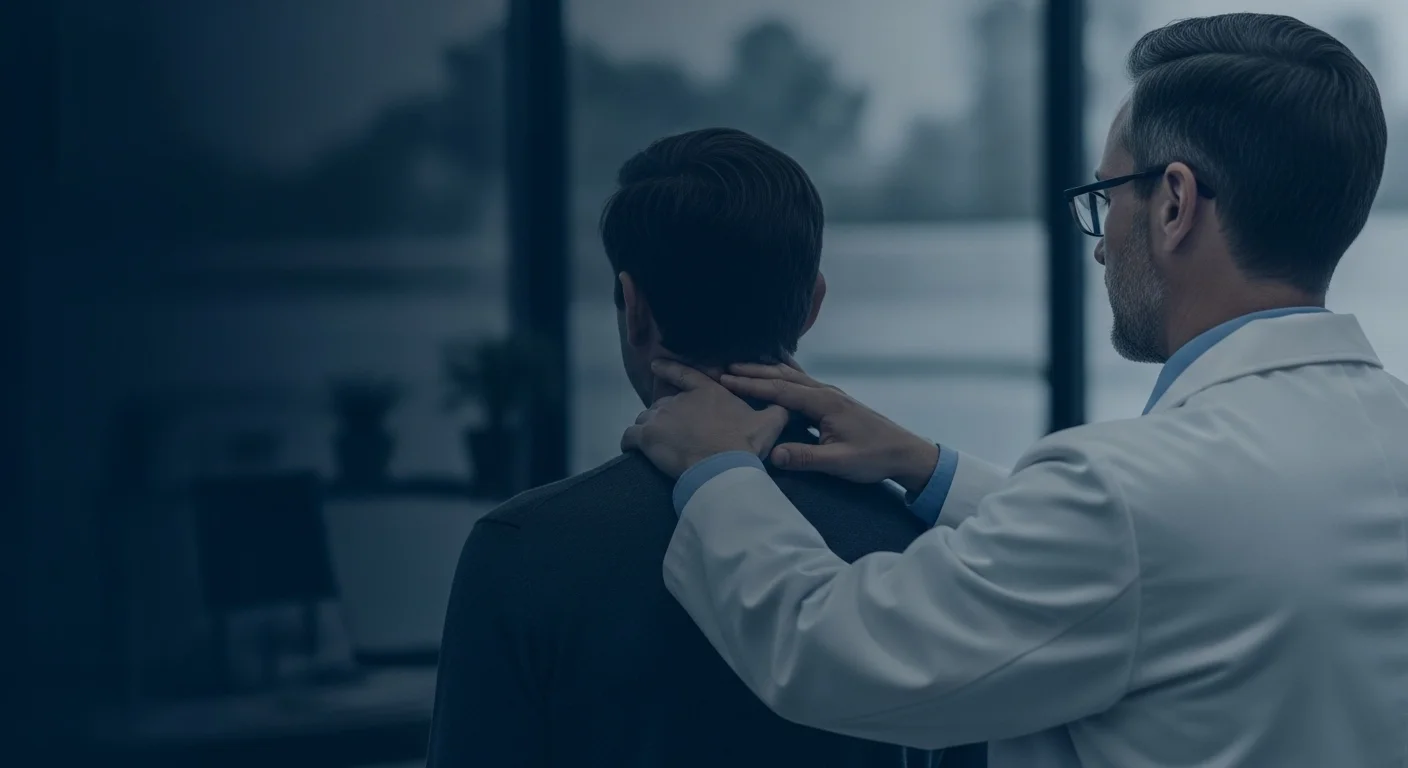
Motor vehicle crashes injured an estimated 2.44 million people across the United States in 2023. Oklahoma’s busiest corridors, the I-35, I-40, and Kilpatrick Turnpike, contribute their share of those cases. Injuries aren’t all treated the same, and some of the most disruptive ones are also the hidden car accident injuries that OKC drivers tend to ignore in the first days after a crash. You might leave the ER with a prescription and a follow-up date, but weeks later, your neck still locks up, and your lower back aches through every shift. Start with our accident care program, which was built for these situations.
This article explains how non-surgical car accident treatment in OKC can interrupt the pain cycle, and why 95% of patients at Oklahoma Pain Treatment Centers recover surgery-free. The OKC car accident doctor team offers same-week appointments across four physical Oklahoma City-area locations, with care led by Dr. Blake Christensen, a fifth-generation Oklahoman and double board-certified interventional pain physician.
Why Waiting It Out Costs OKC Drivers More Than They Think
Common injuries to expect from a motor vehicle accident include whiplash, facet joint sprains, lumbar disc irritation, and post-concussive headaches. Many patients seeking whiplash treatment in Oklahoma City find that symptoms take 24 to 72 hours to fully surface, a pattern documented in a study published in Cureus. Research also shows that whiplash-associated disorders frequently result in sustained pain and disability that extends well beyond the initial injury window.
An untreated pain signal that persists for months can sensitize the nervous system and make later care more complex. Gaps in your medical records also give insurers and opposing counsel reason to argue your injuries were pre-existing or minor.
You can close that gap by working with a car accident pain doctor in Oklahoma City. You receive a precise diagnosis and a documented treatment record that supports your personal injury claim from day one.
What Non-Surgical Car Accident Treatment in OKC Looks Like
Oklahoma Pain Treatment Centers uses a layered, image-guided protocol built around outpatient procedures. Most patients return to normal activity the same day.
Targeted Interventional Procedures
OKPTC physicians use fluoroscopy or ultrasound to place treatments precisely at your pain source. The most common post-collision procedures include:
Epidural steroid injections: Reduce disc and nerve-root inflammation along your cervical or lumbar spine.
Facet joint blocks and medial branch blocks: Diagnose and treat pain from facet joints damaged in the impact.
Radiofrequency ablation (RFA): Uses controlled heat to interrupt pain signals from your injured facet joints, with relief that often extends 12 to 18 months.
Trigger point injections: Release tight, painful muscle bands in the neck, shoulders, and back that develop after whiplash.
Each procedure targets your documented pain source rather than masking symptoms. The goal is durable relief, so you can return to work, family time, and the activities you love.
Coordinated and Regenerative Support
Interventional procedures work alongside physical therapy and activity modification. Where it makes clinical sense, your physician will include regenerative options as part of your interventional pain management plan.
Why 95% of OKPTC Patients Avoid Surgery
When a car accident leaves you considering fusion or discectomy, both these procedures carry real recovery time and real risks, with no certainty of a pain-free outcome. Oklahoma Pain Treatment Centers builds every treatment plan around staying surgery-free from the start, whenever it is safe to do so. That principle shapes how caring for crash injuries works from the first visit onward.
Your treatment approach is sequential. Your care team evaluates each minimally invasive pain treatment before moving to the next. If an epidural steroid injection meaningfully reduces your pain, the next step builds on that result. If medial branch blocks confirm facet-joint involvement, RFA becomes the logical next step. Your pain specialist recommends surgery only when clear red-flag findings call for it, such as progressive neurological deficits or structural instability.
That layered, conservative-first sequencing is why 95% of OKPTC patients avoid surgery. It is a deliberate protocol delivered by a physician fellowship-trained in interventional pain management.
Opioid-Sparing Pain Center for Oklahoma Drivers
Oklahoma ranks among the states with the highest drug overdose death rates in the country, according to the CDC. After a car accident, ER opioid prescriptions are common, and for many patients, those medications become the default long after targeted treatment should have taken over.
Oklahoma Pain Treatment Centers takes an opioid-sparing approach and targets the cause of your pain directly. That can mean sleeping through the night, driving with a clear head, parenting fully present, and showing up at work as yourself again.
Double Board-Certified Interventional Pain Expertise in OKC
Double board-certification means Dr. Christensen has passed board examinations in two separate medical specialties, anesthesiology and interventional pain management. If you are involved in a motor vehicle accident, this matters because a herniated disc at C5-C6 behaves differently from a facet joint injury at L4-L5, and the right diagnosis determines the right procedure. Head injuries follow their own path, and concussion recovery after a collision is judged on different signs.
Documented, image-guided treatment records from a fellowship-trained pain physician also carry more weight with your insurers and attorneys than general chart notes. As a fifth-generation Oklahoman, Dr. Christensen brings that clinical depth to neighbors across the Oklahoma City metro, including Midtown, Bethany, Quail Creek, Belle Isle, and The Greens.
What to Expect at Your First OKC Car Accident Consultation
Your first visit covers an intake review, evaluation of medical records, a focused physical exam, and a personalized non-surgical car accident treatment plan. Oklahoma Pain Treatment Centers accepts med-pay, standard health insurance, and letters of protection, so you can begin non-surgical pain management in OKC right away and coordinate payment through your personal injury settlement later. Billing and treatment are coordinated the same way with the accident clinics at Memorial Park.
Several clinics also don’t require a referral from your doctor.
FAQs: Non-Surgical Car Accident Treatment in OKC
If you were recently in a collision and are weighing your options, these answers cover what most patients want to know before their first visit.
Do I Need an MRI Before My First Visit at OKPTC?
Bring whatever imaging you already have. If additional imaging would guide treatment, the team will order it.
Will OKPTC Treat Me if My Personal Injury Attorney Is Handling the Claim?
Yes, Oklahoma Pain Treatment Centers works regularly with personal injury attorneys and accepts letters of protection.
How Soon After My Accident Should I Come In?
As soon as possible. Early intervention produces better outcomes and creates a documented record that supports your claim from the start. What that first visit examines depends on the injury, and frequent collision injuries and their treatments vary widely.
Is Non-Surgical Car Accident Treatment Covered by Auto Med-Pay in OKC?
In many cases, yes. The team can walk you through your specific insurance situation at your first consultation.
Get Back to Your Life Without Surgery or Opioids
Each year, 2.44 million Americans sustain injuries in collisions, and many recover full function without surgery. Oklahoma Pain Treatment Centers takes a conservative approach to opioids and invasive procedures, with the goal of staying surgery-free whenever it is safe to do so. Schedule your first consultation at an Oklahoma Pain Treatment Center and find out whether non-surgical car accident treatment in OKC is the right fit for you.
Non-surgical treatment after a collision starts with an evaluation. Contact us today and we will build the plan around what the examination shows.